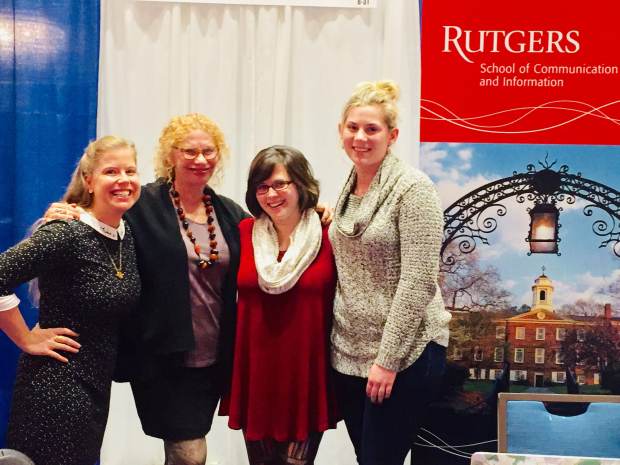
NJASL 2018

Once again I was so fortunate to find myself in Long Branch, NJ for the New Jersey Association of School Librarians Annual Conference. I have attended several times in the past (though I haven’t blogged about all of them), but this was the first time I left the conference more inspired than overwhelmed. This may be, in part, due to my own level of experience and my changing strategy in selecting sessions. However I also feel that this conference was exceptional in and of itself. I also came home with a much lower volume of conference junk that I have in years past, which is definitely positive as I have less to clean up and assimilate back into my regular life this time. 

As is my MO, I got so swept up in the experience of the conference that I forgot to document it visually. This is a chronic professional shortcoming of mine and one I really do need to work on. However, I have to say, on a personal level I don’t see my lack of documentation as strictly poor form. I am taking the time to write about it, after all, and although I am a lover of photographs, writing has always been how I process things best anyway. 

In short, that’s my excuse for not having more photos, though I have wonderful friends who are amazing at documenting life and I was able to swipe some of their photos. 

As I already said, this conference was particularly rewarding and I’m so glad I was able to be there. I attended sessions on reengaging high school students with reading, bridging the skill gap between levels of schooling, digital literacy curriculum development and resources, and several, very inspiring keynotes. I was particularly moved by the talk given by author, Candace Flemming. Her thoughts about telling stories, and her stories about researching her work were just captivating to me. The thought that keeps rattling around in my brain was what she said about primary sources. She pointed out that we have the most boring phrase ever for something that is so inherently magical and exciting. Primary sources are clues from the past. They’re the only scraps left of entire human lives, societies, civilizations. We have papers, photos, and artifacts that we can use to piece together a story, but we can never know the whole thing. Every extra fragment of information that we find that helps us put that story back together should be infinitely more exciting than the phrase, “primary source.”

Rebranding primary sources sounds like a worthy cause to me. Anyone have any ideas? 

In several different sessions it was made clear to me that I need to be more visible and engage more politically. One amazing librarian, Angela Coxen, said that she regularly invited the mayor, sheriff, and any other elected officials she could think of to participate in her library program. She said that libraries that include politics don’t get cut. I think she has a point. 

There’s no end to this post because every conference is more like a beginning of doing this thing called librarianship differently. And isn’t that the point? This is the best profession ever because it’s a new profession ever year. We’re continually remaking ourselves to keep up with the times. Good thing too because I hate being bored. 

NJLA 2018

This was the first time I’d attended a conference since 2015 and it felt good to be back in the swing of large-scale, professional development. By far my favorite part of the conference was, as always, catching up with old friends and colleagues. Several of my former supervisors were there and I had a great time hearing how and what everyone has been up to since we parted ways.

I attended a few very useful sessions that were mostly technology- and teen-oriented. No surprises there. But I was pleasantly surprised by how much I was engaged and interested by a panel of reference librarians speaking about how they serve their communities. Though I am not strictly a reference librarian, I find that my time on the reference desk is my best contact with the student body and informs a lot of the subsequent programming choices that I make. I have long considered my time at the reference desk, in public libraries and in school libraries, ad hoc opportunities to teach. The micro lessons that I teach on the fly at the reference desk are so tailored to the student’s specific needs, that I can’t help but feel that these lessons are probably the most relevant ones I deliver. The reference librarian session also reminded me that, although I’ve always hated tracking the questions that come up, doing so will help us find trends and better serve our students. We don’t currently have a system for inquiry tracking, and I think we should start one. This suggestion may not be popular among some of my colleagues.

The sessions on tech speak and social media were good for me to hear, but another surprisingly interesting session was one I attended on meeting room policies. I went to the session thinking it might give me ideas for solving the issue we have with study room use. The session ended up being much more focused on library rental spaces, but was nonetheless helpful in thinking about how our policies are worded and implemented.

The keynote sessions both days were incredible and focused a lot on diversity and inclusion. It’s funny how my old career is now merging with my new one. I am very happy that conversations about representation, appropriation, identity, diversity, and inclusion have strengthened within the profession. I walked away from both keynote addresses with a long reading list for my own edification.

Since these entries are mostly for me, I will end here. It feels good to have gone to a conference and add some fuel to my professional fire.

NJASL Spring Meeting 2015

It was a privilege to spend the first half of Ultimate Pi Day (3/14/15) at the New Jersey Association of School Librarians Spring Meeting. It was a quick day, but a valuable one.

The keynote speaker took up the majority of the formal programming. Our speaker was Eric Sheninger, who is a big mover and shaker in the world of educational technology in schools. He told us how he, as the principal at New Milford High School, worked with his school librarian to do innovative things with technology in education. The way he explained it, he led the effort to not only make technology work in education, but also to change attitudes about technology. NMHS apparently used to be a place where students would get in trouble for having phones, and now it is a BYOD school with a makerspace in the library and a 3D virtual classroom environment.

A lot of their success had to do with creative resource management and communicating about their projects and successes. The school found money in the budget, grants, and organizations willing to pilot programs with them. Sheninger himself got over his aversion to social media, and educated himself on the actual rules about internet content filters, and opened the gates of online communication.

I’m sharing the link to Sheninger’s virtual handout. It all sounded so incredible that I know that many of us were overwhelmed at the end. It seems unreachable for librarians with really supportive administrators and hopeless budget situations. I can see how it would definitely seem out of reach when looking back at the “finished” product of a success story. But Shininger was quick to also point out how much time the change took, how alone he was at the beginning, how much he relied on the help of others, and that he went through many of the challenges that NMHS faced at first, which are the same for just about every school in NJ.  For me the talk was the perfect balance of inspirational and realistic. Also, I’d like it to be known that at first, he forgot to set the settings of his Google Document to “share” just like the rest of us do sometimes, and he had to go back and fix it. I think that’s probably the 21st century version of “he puts his pants on one leg at a time…”

At lunch I was able to network with some incredible library professionals, who gave me some wonderful career advice, and assured me that library jobs for the fall would likely still be coming out well into May. I am always so inspired when interacting with school librarians. They are consistently some of the most genuinely helpful, welcoming, and naturally curious people I’ve ever met. It’s never difficult to have a conversation in a group of librarians — school librarians especially. Everyone is always learning something and everyone is always excited about what they’re learning and sharing.

We were celebrating the 100th anniversary of NJASL, so many of the past presidents spoke. One of them reminded all of us how important it is to stay engaged in our personal learning network because, for the most part, there is only one school librarian per school. Many school librarians seem to feel that they are the only ones in their building that really understands the challenges and the responsibilities of their job. After hearing that, I’m especially glad that I’ve started building my professional network so early by going to all of these conferences. I would imagine that it would be difficult as a school librarian to take time off of school to go do professional development.

The afternoon was devoted to an unconference format breakout session. I went the the elementary school session since I am student teaching in an elementary school now. I chose to join a discussion on information literacy, which ended up being a discussion about low-tech information literacy. One of the librarians in the group had very few tech resources. The district had to send them 30 Chromebooks for park, and they had to tape lots of extension cords on the floor to plug them all in. Yet the librarian was still teaching information literacy using what she had. These kids are missing out on digital literacy, maybe, but they’re still learning to be great thinkers.

Hilda Weisberg dropped in to give a rousing, if brief talk on advocacy via demonstrating the value of school library, and then our day was over and we all had to head back out into the rain.

No photos this time, but there was a hashtag on Twitter than can be accessed here:
//

ALA Midwinter Meeting 2015

Library conferences get better and better each time I go. Even with a blizzard on the Sunday and catching a cold halfway through, it was such a worthwhile conference for me. I reconnected with some old colleagues from Syracuse, met some new friends from all over the country and I was inspired by the many speakers and presenters that I saw.

I would be lying if I said that meeting LeVar Burton wasn’t the opportunity that pushed me over the edge when I was teetering on the decision of whether or not to go. Chicago in January is a rather difficult sell after all, and Chicago did not hold back. The very day that LeVar Burton was scheduled to speak there was a full on blizzard in the city. Librarians are not deterred by the weather and the shuttle drivers showed a truly heroic effort in taking us back and forth from hotel to venue safely. It is important to remember all of the people who make these events possible.

The celebrity appearances surpassed all expectations, but there were some surprise highlights for me as well. Several Ignite sessions focused on diversity in our collections and librarians spoke powerfully about their experiences and their book suggestions. The Women in Geekdom panel blew me away, and turned me on to several new obsessions: The Brain Scoop YouTube channel with the ebullient Emily Graslie, who spoke on the panel, is an incredible natural science resource. I watched every video on the channel upon returning home and it is not only accessible and fun to watch, but it is incredibly informative and inspiring to see a young woman pursue her passion in science so creatively and pro-actively. I’ve been telling everyone I know about the channel and I can’t wait for more videos to come out. The Nerdette Podcast made it on my to-listen list. I haven’t gotten to it yet, but Chicago public radio host, Tricia Bobeda, spoke passionately about her love of outer space and how she makes the podcast for free. All of the incredible women on the panel spoke so encouragingly about encouraging women to take ownership of STEM fields and urging everyone to include men in that conversation. At the end of the session many of the attendees got up to speak about their experiences with programming STEM activities or “geeky” activities, so I got up my courage to speak about the technology tutoring program I run for seniors in my public library. Most of my students are women and they are being proactively techy too! I got a new Twitter follower for my courage.

I firmly believe in making time to see more than just the venue when I am at a conference in another city and I was lucky to be at the conference with a colleague who feels the same way. Together my friend and I explored the truly excellent Field Museum — Chicago’s museum of natural history. We only had time to visit the taxidermy and fossil collections, but both exhibits were detailed and engaging. One thing that caught our attention were the phylogenic tree illustrations in the Evolving Planet exhibition. They were simple, yet informative diagrams that showed how each species in each exhibit evolved. Even as pretty hard core natural history museum enthusiasts, we learned a few new things…including the word “phylogenic.”

Delayed flights on the last day of the conference meant that I also had time to visit the Shedd aquarium, which is also very good, though my friend and I opted not to buy the expensive tickets to go see the sharks and penguins, so that led our visit to be a little underwhelming when compared with our experience at the Field Museum. Ultimately I came away from Chicago having learned a lot, acquired more books than was strictly necessary, and I did a lot of very useful and exciting networking. A success all around.