Project Overview
I came to La Casita Cultural Center is a program of the College of Arts and Sciences at Syracuse University. It is a community center, art gallery, and cultural heritage preservation organization dedicated to serving, and documenting the experience of the Latino/a population of Syracuse, NY. As soon as I found out that La Casita was in the process of establishing a bilingual library, I knew I had to be involved somehow.
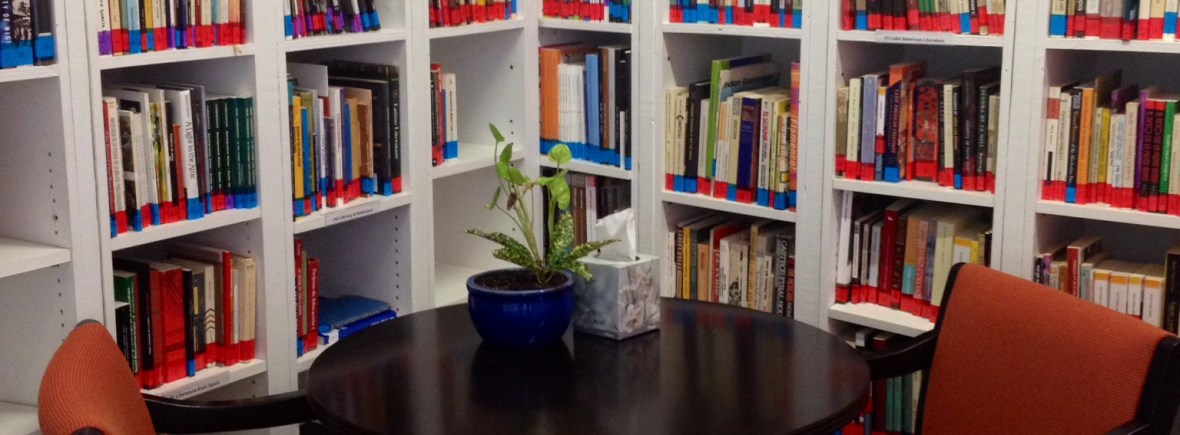
La Casita had already acquired 1500 – 2000 volumes in the 2012 – 2013 academic year, when the project began, and the books were on the shelves ready to be used. However after meeting with the director, it transpired that people were afraid to touch the books and the staff was unsure how to keep track of their collection.
I consulted with the library project’s supervising professor at the School of Information Studies, and a representative from the Central NY Library Resource Center (CLRC), to put together a plan for the library’s future.
Phase one
- Sort through the books
- Weed through new donations
- Assess existing subject categories (e.g. Young Adult Fiction; Classic Spanish Literature)
- Update the inventory Excel sheets from the initial project proposal
- Develop a spine labeling system that would support browsing
- Call number: subject category & author’s last name
- Color sticker on the spine: language of the text (Spanish, English, or bilingual)
- Design a book stamp for La Casita’s books and stamp the entire collection
- Create a hard-copy circulation binder that would allow patrons to take books out of the library at La Casita staff member discretion
Phase Two
- Set up an open-source, online catalog that supports the circulation of the collection
- Add library barcodes to the books
- Catalog the books with Spanish- and English-language authority records
Outcome
By the end of the 2013 – 2014 academic year, Phase One was complete. All of the books in the collection were labeled and shelved in their subject sections. A colleague at CLRC actually did set up the open-source catalog using Koha. However until there are more funds available to the library project, the implementation of Phase Two remains out of reach. My assessment that La Casita would need a person dedicated to the management of the library and the means to purchase Spanish-language authority records. This second phase would allow patrons to explore the library’s collection remotely and search in their preferred language.
My experience at La Casita was extremely helpful in my understanding of cataloging and what it takes to organize a library collection. I needed to work with colleagues to problem-solve creatively, and I am very proud of how this project turned out. I must extend my thanks to La Casita’s incredible staff, for putting their trust in me and maintaining this project after my departure, and to my colleagues at CLRC always jumping in to lend a hand.


 Ruth A. Quiles